

Understanding the Stages of Early-Stage Funding in India: A Complete Breakdown
Introduction
In India’s startup ecosystem, understanding the “stages of early-stage funding” is critical whether you’re a founder seeking investment or an investor evaluating deals. For many entrepreneurs the terms “seed”, “Series A”, “pre-seed”, “growth” are used loosely. But clarity matters: stage determines investor expectations, valuation brackets, milestone timelines, and dilution dynamics.
As India enters 2026, the funding landscape is both maturing and tightening. According to recent data, early-stage (seed + Series A) funding in India witnessed a slowdown: seed-stage funding in H1 2025 dropped to USD 452 million (-44% vs H1 2024) while early-stage overall stood at USD 1.6 billion (-16% YoY). Read More
Definitions: What Are the Funding Stages?
Below is a simplified breakdown of the commonly used stages in India’s early-stage funding spectrum.
Stage | Typical Purpose | Typical Check-Size / India Context* |
Pre-seed / Angel | Founders validate idea, build MVP, early customer/proof-of-concept. | ~US$100k-500k (varies widely) |
Seed | Product market fit seeks validation, initial traction, early hires, “go-to-market” pilot. | In India, could range US$0.5–3 m (≈ ₹4-25 cr) |
Series A (Early stage) | Scaling product/market fit, building team, repeatable business model, looking at meaningful growth. | India: ~US$3–15 m typical. Read More |
Series B & Growth onward | Scaling operations, international expansion, major revenue ramp, possibly exit path. | >US$10 m+ and a commensurate valuation. |
* Note: These are indicative; actual ticket sizes vary by vertical (deep-tech, SaaS, hardware), geography, investor appetite.
Why does stage-definition matter?
- It sets investor expectations (what you should have achieved).
- It influences valuation and dilution (earlier = higher risk = lower valuation).
- It defines what milestones you must hit before raising the next round.
- It shapes your fundraising timeline and strategy (how many months/years until next raise).
Investor Expectations by Stage
Here’s a breakdown of what investors typically expect at each funding stage in the Indian market.
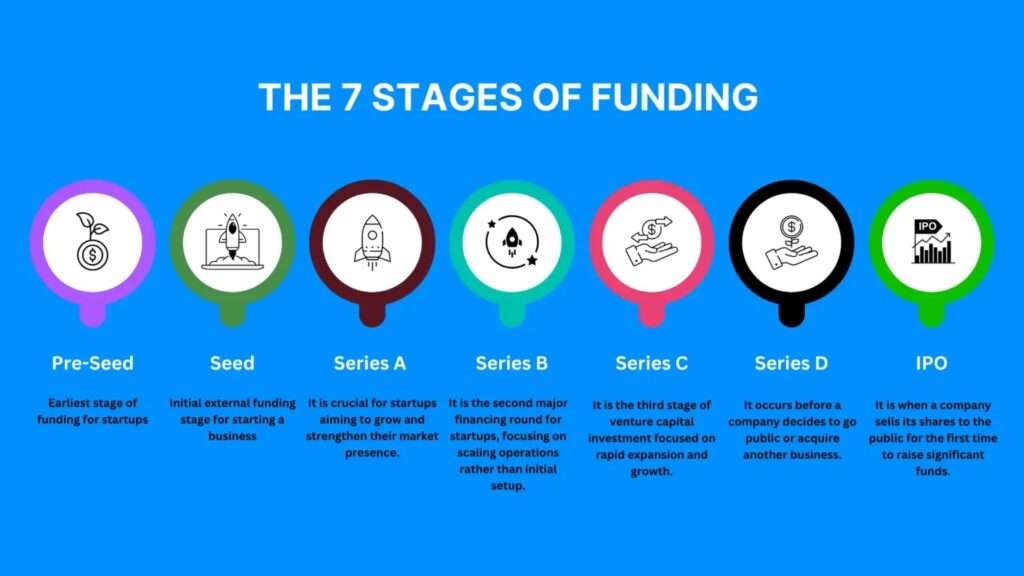
Source: Startup Rise Asia-Pacific
Pre-seed / Angel
- A founding team with domain expertise or strong prior experience.
- Early prototype/MVP or at least idea plus validation plan.
- Clear value proposition and initial market insight.
- Some user interest, pilot customer or LOI ideally.
- Willingness to accept high risk and long time to exit.
Seed
At this stage, the investor is looking for:
- A working product or clear MVP with initial users/customers and measurable engagement.
- Evidence of product-market fit or strong hypothesis.
- Founding team plus early hires (e.g., tech, go-to-market).
- A credible go-to-market strategy, target metrics (CAC, retention) even if early.
- Plan for next 12-18 months: how the money will be used, major milestones.
- Reasonable dilution (often 10-25 %) depending on valuation.
Series A (Early Stage)
Investors expect:
- Already some measurable traction (revenue, paying customers, repeatable model) rather than just “idea”.
- Clear unit economics or path to them.
- Scalable model: ability to grow team, expand markets, build processes.
- Strong metrics: e.g., ARR, growth % MoM, churn, margin improvements.
- Intention/plan for further rounds, possible exit paths.
- Governance, investor readiness, professionalised operations.
Series B and Beyond
- Significant revenue scale, ideally profitability or path to profitability.
- Expansion into new markets (geographic or product).
- Competitive moat: IP, brand, distribution, cost advantage.
- Institutional investor involvement, potential merger/acquisition/IPO strategy.
- Strong management team, often with external hires for scale operations.
Funding Timeline & Benchmarks for India
Here’s a rough timeline and benchmarks for Indian startups in early-stage, especially in tech/hardware/hybrid contexts. Note: Deep-tech companies often take longer and need higher tickets.
Stage | Approx Time to Reach | Key Milestones |
Pre-seed → Seed | 6-18 months | MVP built, early customers/pilots, team in place |
Seed → Series A | 12-30 months | Product-market fit, recurring revenue (ideally), scalable GTM, measurable traction |
Series A → Series B | 18-36 months or more | Significant ARR, growing team, multi-market presence, strong unit economics |
India Funding Context: Late‑2025 / Early‑2026
Data from the first half of 2025 signaled a shift in India’s startup funding landscape. Seed-stage funding dipped to about USD 452 million (‑44 % YoY), while early-stage funding (seed + Series A) totaled around USD 1.6 billion (‑16 % YoY). Total startup funding for 2025 eased to roughly USD 10.5 billion, a 17 % drop from 2024, though early-stage deals remained relatively resilient at USD 3.9 billion, reflecting investors’ focus on measurable traction and scalable models. Read More
Implications for founders:
- Align your funding ask with your current stage – overreaching is risky.
- Demonstrable traction – revenue, paying customers, or unit economics – is critical.
- Investors are selective, prioritizing rounds that clearly accelerate growth.
In this environment, stage-fit, milestones, and scalability are more important than ever as India moves into 2026.
Key Metrics & Characteristics by Stage
Here are some typical metric-benchmarks (though always variable by sector) that investors use to assess stage readiness:
Stage | Metrics to Show | What Investors Focus On |
Seed | Prototype/MVP, early users, MoM growth %, CAC, churn (if any) | Team strength, product-market fit hypothesis, runway |
Series A | ARR or MRR (for SaaS), paid customers, growth % (e.g., 5 – 10%+ month-on-month), unit economics, retention curves | Scalability, business model repeatability, process readiness |
Series B+ | Significant revenue (US$5+ m+ ideally), gross margin, EBITDA progression, multi-geography or major product expansion | Market leadership, global ambition, exit potential |
For deeper tech/hardware startups:
- Additional metrics: TRL (Technology Readiness Level), manufacturing/scale readiness, IP/patents, gross-margin improvement via scale, supply-chain robustness.
- These startups may raise larger tickets but also run longer timelines and higher risks; investors will model longer runway and larger capital commitment.
How This Applies to Indian Founders & Investors
From Seafund’s vantage point (as a deep-tech early-stage investor), the key take-aways for Indian founders are:
- Aim for the right stage: Align your ask with what you’ve actually achieved. Don’t present a “seed-stage ask” when you’re still pre-product, nor a “Series A” ask when you lack traction.
- Focus on measurable milestones: Given the tighter environment, investors want to see early validation, customers, or pilots—even at seed.
- Build for scalability and capital-efficiency: Early days matter. Investors ask: “What happens when we inject X ₹ crore — what major milestone will you hit?”
- Plan for follow-on investment: Even beyond your current round, know how you will hit next round. Deep-tech especially needs longer horizon.
- Expect tougher scrutiny in 2025: As data shows, early-stage funding is down; valuations compressed; investor patience higher.
- Tell the story of global ambition & scalable model: India is large, but investors increasingly look at global potential and repeatable business models.
Quick Reference Table: Funding Stage Summary
Stage | Purpose | Typical India Ticket | What You Should Provide |
Pre-seed | Idea → MVP | US$0.1-0.5 m | Founding team + prototype + market insight |
Seed | Validate & scale initial model | US$0.5-3 m | MVP in market, early users/pilot, GTM plan, team build |
Series A | Scale model & business | US$3-15 m | Revenue or strong traction, scalable model, growth metrics, unit economics |
Series B+ | Major expansion | US$10 m+ | Significant revenue, market leadership, international expansion, clear exit path |
Conclusion
For Indian startups – especially those in deep-tech, hardware or hybrid models – the roadmap from idea to exit encompasses distinct funding stages, and each stage carries different expectations. As 2026 marks a more disciplined phase of funding in India, founders must sharpen their stage readiness, build measurable traction, align their ask with actual progress, and demonstrate the ability to scale – not just locally, but globally.
At Seafund, we encourage founders to map their milestones, understand investor psychology, and present a clear vision for scale and exit. Know your stage. Raise accordingly. And build with clarity. Because in today’s environment, the right stage-fit and execution can make all the difference.
FAQs
- What are the early-stage funding stages in India?
Pre-seed, seed, and Series A are the main early-stage funding rounds in India. - How much funding is raised at the seed stage in India?
Seed rounds typically range from US$0.5–3 million, depending on sector and traction. - What do investors expectatSeries A?
Revenue or strong traction, scalable business model, and clear unit economics. - Why is early-stage funding slower in India in 2025?
Investors are cautious due to market correction, focusing on metrics and capital efficiency. - How should founders prepare for early-stage fundraising?
By aligningthe funding ask with traction, milestones, and growth readiness.
Table of Content
- 1. Introduction
- 2. Definitions: What Are the Funding Stages?
- 3. Investor Expectations by Stage
- 4. Funding Timeline & Benchmarks for India
- 5. Key Metrics & Characteristics by Stage
- 6. How This Applies to Indian Founders & Investors
- 7. Quick Reference Table: Funding Stage Summary
- 8. Conclusion
- 9. FAQs