

From Idea to Factory: Advanced Manufacturing & IP-led Hardware in India
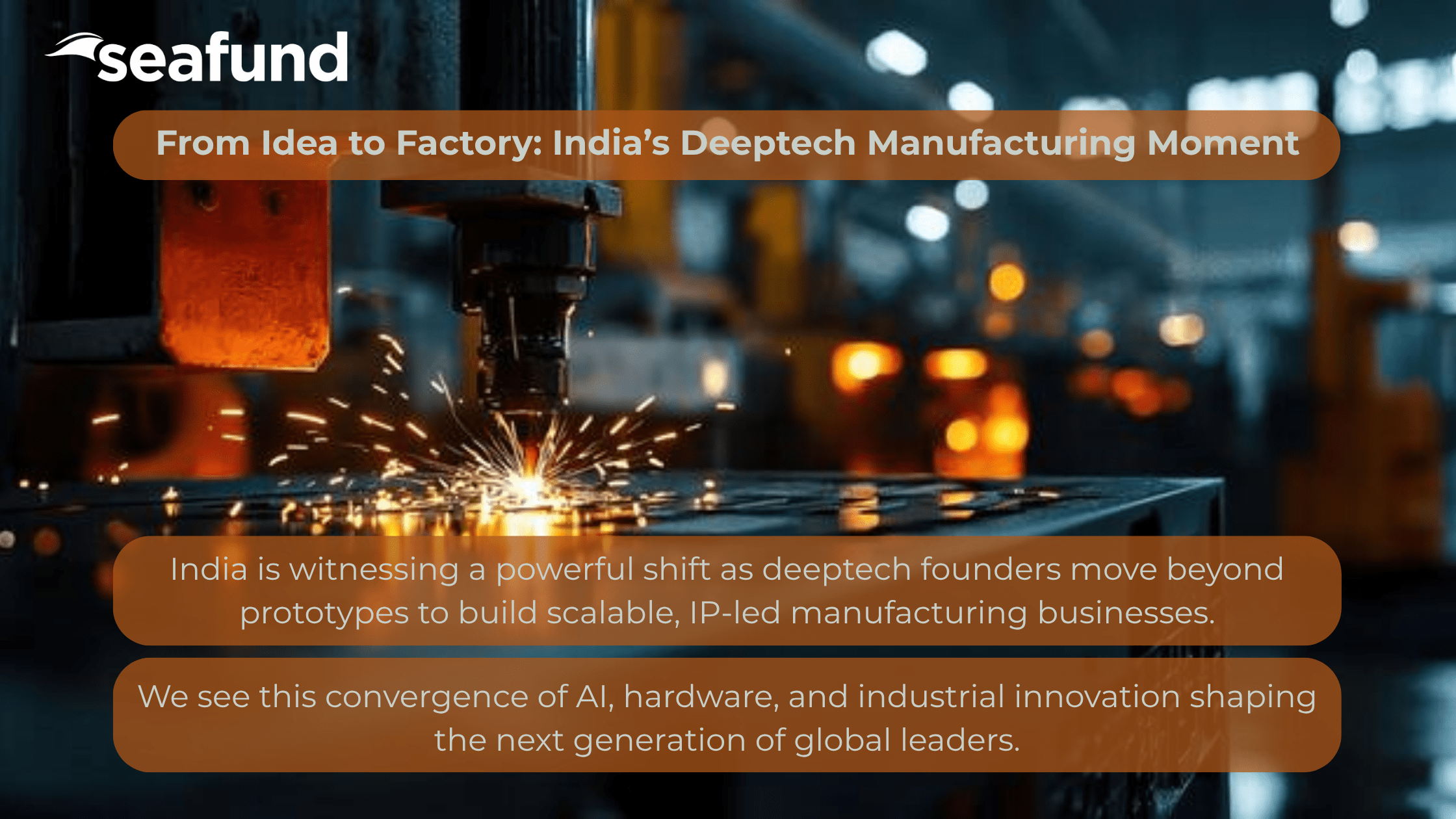
Every few years, a shift happens in how technology gets built. In the last decade, it was software. Today, in India, it is increasingly about something more physical, more complex, and arguably more transformative: taking an idea all the way to a factory floor.
Across the country, a new class of founders is emerging; engineers building robotics systems, AI-driven factories, advanced materials, semiconductors, and hardware platforms. These are not traditional manufacturing companies. They are advanced manufacturing startups in India, where software, IP, and industrial engineering come together.
At Seafund, we see this shift as one of the most important long-term opportunities in deeptech investing.
But building in this space is very different from building a SaaS product. It is slower, heavier, more capital-intensive, but also far more defensible when it works.
Why Advanced Manufacturing Is Having Its Moment in India
A founder recently told us:
“In software, you ship code. In hardware, you ship reality.”
That sentence captures the essence of this shift.
India’s manufacturing story is being rewritten by three forces coming together:
- Global supply chain diversification
Global companies are actively reducing dependence on single-country manufacturing hubs and looking at India as an alternative base.
- Policy tailwinds
Government programs like the Production Linked Incentive (PLI) scheme have accelerated investment in electronics, EVs, and advanced manufacturing. You can explore the official framework here:
https://www.investindia.gov.in/production-linked-incentives-schemes-india
- Technology convergence
AI, robotics, IoT, and advanced materials are no longer separate domains. They are merging into industrial AI India, reshaping how factories operate.
The result is a powerful opening for founders building in manufacturing automation startups in India and IP-heavy hardware companies.
The Real Challenge: From Prototype to Production
Most founders in this space don’t struggle with ideas. They struggle with the gap between a working prototype and a scalable factory product.
We often see three phases:
Phase 1: Lab validation
A working prototype is built, a robot, sensor, material, or system.
Phase 2: Pilot deployment
The product is tested in real environments, factories, hospitals, energy plants, or defense settings.
Phase 3: Industrial scaling
This is where most startups either break through or break down.
Unlike software, scaling hardware is not just about demand. It is about:
- Supply chain stability
- Manufacturing yield
- Cost reduction per unit
- Reliability under stress conditions
This is why hardware startup funding in India requires patience and a different underwriting lens.
Different Ways Founders Are Building in Advanced Manufacturing
There is no single “startup model” in this space. Instead, we see multiple archetypes emerging.
- FablessDeeptechCompanies
These startups design core technology but outsource manufacturing.
A good global reference is NVIDIA, which became dominant by focusing on design and IP while relying on fabrication partners.
In India, similar approaches are emerging in semiconductors and embedded systems.
- Strong IP ownership
- Asset-light model
- High scalability potential
- Contract Manufacturing + Smart Automation
Traditional contract manufacturers are evolving into tech-enabled factories.
With the rise of robotics and AI, many are becoming part of the manufacturing automation startups India ecosystem.
We are seeing factories adopt:
- AI-based defect detection
- Predictive maintenance systems
- Automated assembly lines
A useful reference point is how global EMS companies like Foxconn are increasingly integrating AI-driven production systems:
https://www.brookings.edu/articles/the-future-of-manufacturing-is-smart/
- VerticalDeeptechManufacturers
These companies build end-to-end products: EV components, drones, medical devices, or energy systems.
They are capital-intensive but deeply defensible when successful because they own both:
- IP
- Manufacturing capability
This is where the “idea to factory” journey becomes most visible.
Capital Reality: Why Hardware Is Harder (and Worth It)
One of the most misunderstood aspects of this space is capital intensity.
Unlike software startups that can scale with minimal infrastructure, hardware startups must invest early in:
- Tooling and machinery
- Material science and testing
- Compliance and certifications
- Pilot production lines
This is why hardware startup funding in India often involves longer timelines and staged capital deployment.
What strong cap tables look like
Successful companies in this space typically raise from:
- Deeptech-focused VCs
- Strategic manufacturing partners
- Government grants
- Patient capital investors
The key is alignment on time horizons, not just valuation.
Case Study Lens: What Good Looks Like
Case 1: Robotics in logistics (global reference)
Companies like Boston Dynamics show how robotics moves from research to real-world industrial adoption, but only after years of pilot testing and refinement.
https://www.bostondynamics.com/
Lesson for India: Deeptech adoption is slow, but once it enters workflows, it becomes sticky and scalable.
Case 2: India’s drone ecosystem
India’s drone startups have grown significantly post-policy reforms like the Drone Rules 2021:
https://www.civilaviation.gov.in/en/about-aircraft-act-1934
Many startups started with defense pilots and are now expanding into agriculture, surveillance, and logistics.
Lesson: Government-enabled pilots are often the first step toward scale.
What Investors Look For (Beyond the Pitch Deck)
At Seaund, we often say: in manufacturing, the pitch deck is the least important document.
What matters more is:
- Proof of physics
Does the product actually work in real environments?
- Pilot traction
Has it been deployed beyond controlled lab conditions?
- Unit economics trajectory
Is there a clear path to cost reduction at scale?
- Supply chain understanding
Do founders understand sourcing, manufacturing constraints, and vendor dependencies?
- Founder resilience
This is a long game. Execution matters more than speed.
The Founder Reality: It Takes Time, But It Compounds
Most successful founders in this space don’t start with perfect products. They start with imperfect prototypes and iterate in the field.
One of the most consistent patterns we see is:
Founders who stay closest to the factory floor win.
They don’t treat manufacturing as a backend process. They treat it as the product itself.
The Road Ahead: India’s Idea-to-Factory Moment
India is at a rare inflection point where:
- Policy support is strong
- Global supply chains are shifting
- AI is entering industrial systems
- Talent is becoming more hardware-aware
This is creating a new category of companies that sit at the intersection of industrial AI India, robotics, and advanced manufacturing.
The winners will not just design products; they will own the journey from idea to factory.
At Seafund, we believe this is where India builds its next generation of global industrial leaders.
And for founders willing to take the harder path, this is one of the most rewarding ones.
FAQs
- What is advanced manufacturing and why is it growing in India?
Advanced manufacturing combines AI, robotics, and IoT with traditional production, and is growing due to policy support, global supply chain shifts, and deeptech innovation.
- Why is scaling hardware startups more challenging than software startups?
Hardware startups face challenges like supply chains, manufacturing complexity, and high capital needs, making scaling slower than software.
- What are the common business models in advanced manufacturing startups?
Startups typically follow fabless (IP-led), contract manufacturing with automation, or vertically integrated models.
- What do investors look for indeeptechhardware startups?
Investors focus on real-world validation, pilot traction, scalable unit economics, and strong execution-focused teams.
- Is hardware startup funding in India improving fordeeptechfounders?
Yes, funding is improving with support from VCs, government initiatives, and strategic partners, though timelines remain longer.
Table of Content
- 1. Why Advanced Manufacturing Is Having Its Moment in India
- 2. The Real Challenge: From Prototype to Production
- 3. Different Ways Founders Are Building in Advanced Manufacturing
- 4. Capital Reality: Why Hardware Is Harder (and Worth It)
- 5. Case Study Lens: What Good Looks Like
- 6. What Investors Look For (Beyond the Pitch Deck)
- 7. The Founder Reality: It Takes Time, But It Compounds
- 8. The Road Ahead: India’s Idea-to-Factory Moment
- 9. FAQs