

Why Are Quantum Startups So Hard to Build in India?
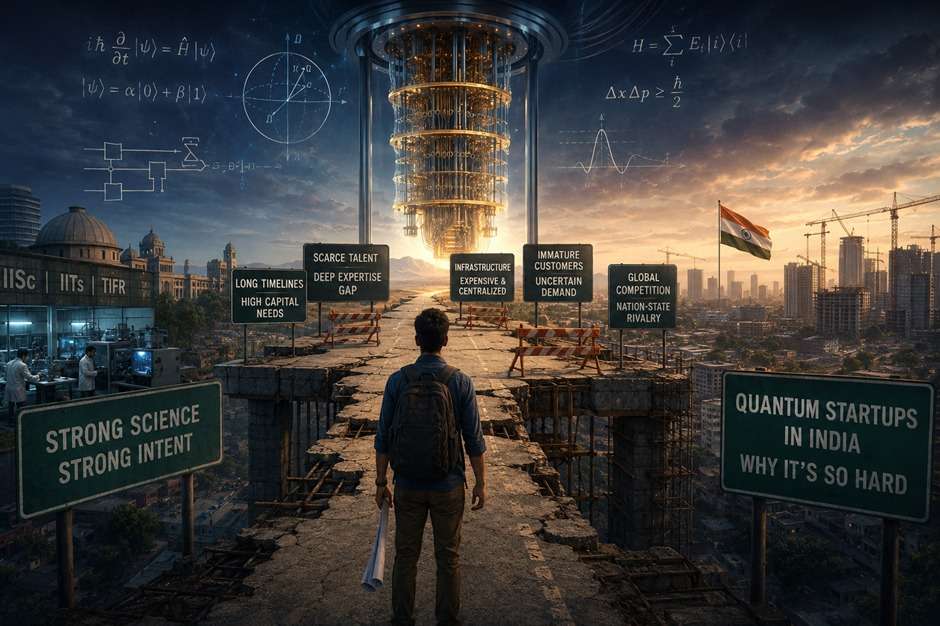
1. Does India lack scientific talent?
No.
India has strong talent in physics, mathematics, computer science, and engineering, with institutions like Indian Institute of Science, Tata Institute of Fundamental Research, and the IITs contributing meaningful research. The National Quantum Mission has also signalled growing policy intent.
The problem is not intelligence. It is ecosystem alignment.
Quantum startups need science, infrastructure, capital, industry adoption, and policy support to evolve together. India has pieces of this ecosystem, but the coordination between them is still limited.
2. Why doesn’t quantum fit the normal startup model?
Because quantum moves slowly and consumes capital early.
Unlike software startups, quantum companies often spend years building core technology before commercial outcomes become visible. Capital goes into:
- Labs and cryogenics
- Precision electronics
- Fabrication access
- Specialised talent
Progress is nonlinear, customer demand is immature, and revenue visibility is weak.
That makes quantum difficult for venture ecosystems built around fast feedback loops.
3. Why aren’t strong research institutions enough?
Because research strength does not automatically create startup capability.
Quantum startups need people who can move systems from lab experiments into usable products:
- Hardware engineers
- Cryogenics specialists
- Control systems experts
- Quantum software researchers
- Product teams with real systems experience
India has talent, but relatively few teams with end-to-end operational experience in quantum systems.
As a result, many startups end up handling scientific, engineering, and commercial risk simultaneously
4. Why is infrastructure a bottleneck?
Because quantum hardware is extremely expensive and specialised.
It requires:
Ultra-low temperature systems
Vibration-free environments
Precision electronics
Advanced fabrication infrastructure
Much of this infrastructure in India still sits inside universities or government labs, where startup access can be slow.
The alternative is rebuilding infrastructure privately, which burns capital quickly.
5. Is funding improving?
Yes, but quantum still sits outside the comfort zone of most investors.
India’s deeptech ecosystem is growing, with firms like:
showing increasing interest in science-led startups.
But quantum requires:
- Large, patient capital
- Long timelines
- Tolerance for uncertain outcomes
- Willingness to fund infrastructure-heavy businesses
That type of capital is still limited.
6. Are there enough customers?
Not yet.
Globally, most quantum customers today are:
- Governments
- Defence organisations
National labs - A small number of enterprises
India’s enterprise ecosystem is still early in quantum adoption, which makes revenue timelines uncertain.
7. Why is talent density important?
Because quantum systems are deeply interdisciplinary.
Strong teams require expertise across:
- Physics
- Cryogenics
- Semiconductor systems
- Microwave engineering
- Quantum software
- Error correction
India has capable talent across these areas, but concentrated experience building full-stack quantum systems remains rare.
8. How difficult is the global competition?
Extremely.
The US, China, and Europe are investing tens of billions into quantum research, infrastructure, semiconductors, and defence-linked programs.
Indian startups are competing not just with companies, but with nation-scale ecosystems.
9. Are there promising Indian quantum startups?
Yes.
Companies like QpiAI and QNu Labs are building serious capability in quantum computing and communication.
The ecosystem is still early, but momentum is visible.
10 What is the core takeaway?
Quantum startups are hard because they require alignment across too many layers at once:
- Long-term capital
- Advanced infrastructure
- Dense technical talent
Institutional coordination - Early customers
- Policy continuity
Most startup sectors can survive fragmented ecosystems.
Quantum usually cannot.
Which is why quantum may ultimately look less like a traditional startup category and more like national infrastructure emerging through entrepreneurial companies.
Table of Content
- 1. Does India lack scientific talent?
- 2. Why doesn’t quantum fit the normal startup model?
- 3. Why aren’t strong research institutions enough?
- 4. Why is infrastructure a bottleneck?
- 5. Is funding improving?
- 6. Are there enough customers?
- 7. Why is talent density important?
- 8. How difficult is the global competition?
- 9. Are there promising Indian quantum startups?
- 10. What is the core takeaway?