

Why Capital Efficiency Will Matter More Than Capital Raised
Introduction
For nearly a decade, startup success was often measured by the size of funding announcements. Larger rounds signaled momentum; valuations reflected optimism, and rapid scaling became the default operating model across the venture ecosystem.
But the market has changed.
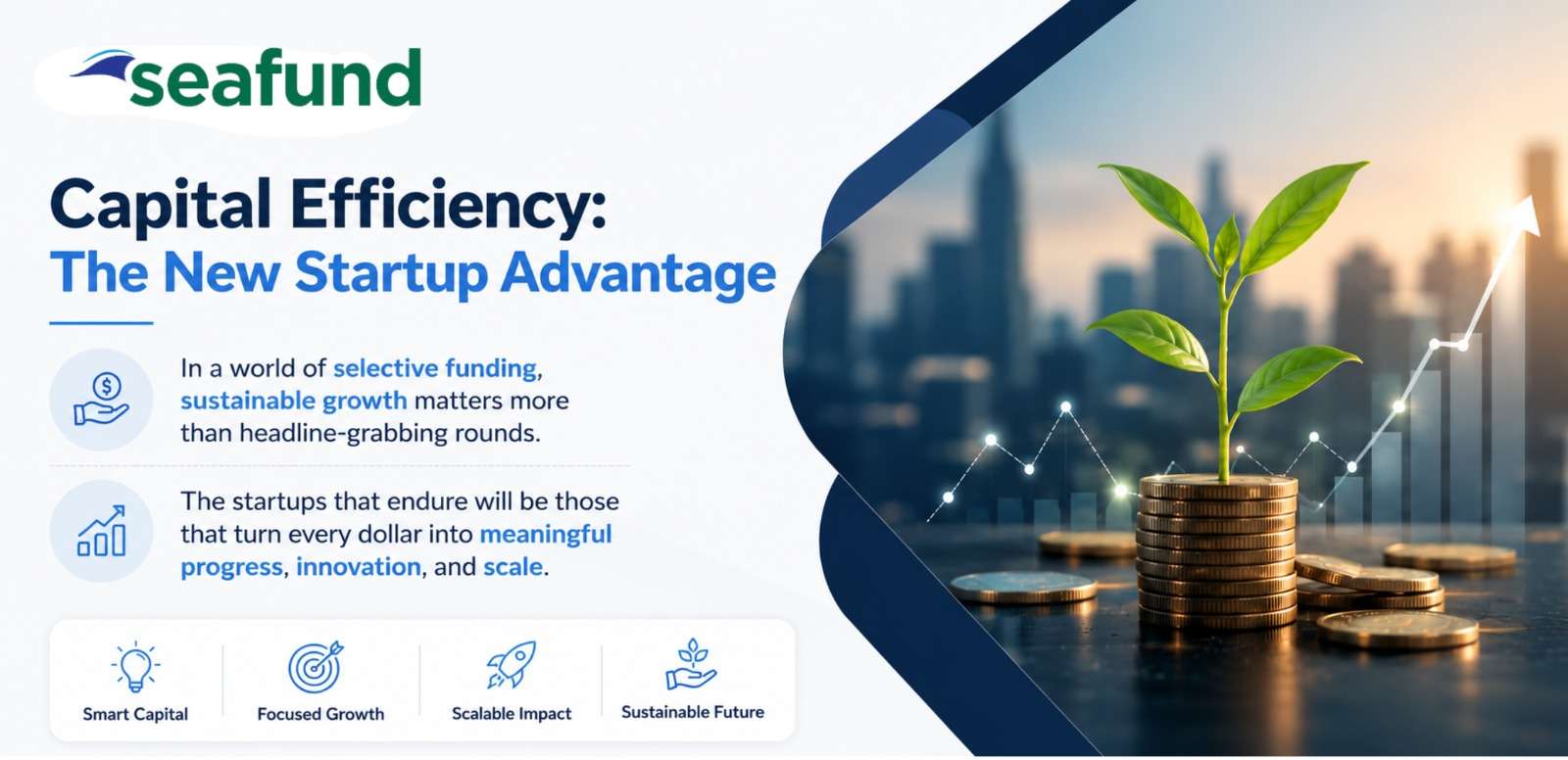
Today, founders, operators, and investors are entering an era where capital is no longer assumed to be endlessly available. Rising interest rates, global funding slowdowns, longer enterprise sales cycles, and increasing investor scrutiny have reshaped how startups are evaluated. The conversation is shifting from “How much did you raise?” to “How efficiently are you building?”
According to CB Insights’ State of Venture Report, global venture funding continues to remain selective, with investors increasingly prioritizing profitability pathways, operational efficiency, and sustainable growth metrics over hyper-aggressive expansion.
For deeptech startups especially, this shift is significant. Unlike pure software businesses, deeptech ventures often operate with longer R&D cycles, infrastructure costs, hardware dependencies, regulatory requirements, and delayed commercialization timelines. As a result, capital allocation becomes a strategic capability – not just a financial necessity.
At Seafund, this evolution is highly relevant to how early-stage innovation is assessed. In today’s ecosystem, the strongest startups are not necessarily the ones that raise the most capital, but the ones that can convert capital into defensible, scalable, and sustainable business outcomes.
The Rise of the Capital-Efficient Startup
The modern capital efficient startup is fundamentally different from the “growth-at-all-costs” companies that dominated previous funding cycles.
Capital efficiency does not mean minimizing spending at every step. Instead, it means allocating resources with precision toward activities that directly create enterprise value.
This includes:
- Faster validation cycles
- Sustainable revenue growth
- Strong unit economics
- Efficient customer acquisition
- Disciplined hiring
- Strategic R&D deployment
- Longer operational runway
Research from McKinsey & Company highlights that companies balancing growth with operational efficiency consistently outperform businesses pursuing unchecked expansion during uncertain economic cycles.
In practice, an efficient growth startup focuses less on vanity metrics and more on measurable business durability.
Burn Rate vs Runway: New Investor Expectations
One of the clearest changes in the startup ecosystem is how investors evaluate burn.
During the peak funding years, startups frequently optimized for speed over sustainability. Large teams, aggressive customer acquisition, and rapid market expansion were often rewarded even without clear monetization pathways.
That model is becoming increasingly difficult to sustain.
Today, investors expect founders to maintain significantly healthier runway positions. According to PitchBook’s Venture Monitor, venture firms are encouraging portfolio companies to preserve longer cash runways as fundraising cycles continue to lengthen globally.
A strong runway strategy now typically involves:
- Maintaining 18–24 months of operational visibility
- Aligning burn with measurable business milestones
- Delaying non-essential expansion
- Preserving fundraising optionality
- Reducing dependency on bridge financing
For deeptech companies, these expectations are even more important because technical commercialization often takes longer than traditional SaaS or consumer internet businesses.
This is where a thoughtful VC funding strategy becomes essential. Founders are increasingly realizing that raising excessive capital too early can create operational inefficiencies, unrealistic growth expectations, and unnecessary dilution pressure.
Instead of optimizing the largest round possible, many successful startups are now optimizing milestone-based fundraising – raising enough capital to unlock the next stage of defensible growth.
As outlined in Seafund’s investment approach, operational resilience and long-term scalability are becoming central indicators of startup quality within the deeptech ecosystem.
Building Capital-Efficient Technology Companies
Capital efficiency begins long before fundraising. It is embedded into how companies build products, structure teams, and prioritize growth.
- Focus on Core Problem Solving
Many startups lose efficiency by overbuilding too early.Deeptech startups achieve stronger outcomes when they focus on solving high-value, mission-critical problems rather than building broad feature-heavy platforms prematurely.
A focused product roadmap helps:
- Reduce engineering waste
- Accelerate customer feedback loops
- Improve commercialization speed
- Strengthen product clarity
The most successful deeptech businesses typically dominate narrow but high-impact problem spaces before expanding horizontally. - AI and Automation as Efficiency Multipliers
AI-native operations are rapidly becoming one of the strongest drivers of startup efficiency.From engineering productivity to customer support automation, startups are increasingly leveraging AI tools to improve output while maintaining lean organizational structures.
According to Harvard Business Review, AI-driven productivity gains are fundamentally changing how businesses approach workforce scaling and operational execution.
For startups, this creates a major opportunity:- Smaller teams can achieve higher execution velocity
- Repetitive workflows can be automated
- Founders can allocate more resources toward innovation and strategic growth
This becomes especially valuable for deeptech startups where engineering bandwidth and R&D focus are critical for competitive assets.
Hiring Efficiency Will Matter More Than Team Size
The startup ecosystem is also redefining what “good scaling” looks like.
For years, rapid hiring was interpreted as proof of growth. Today, lean and highly accountable teams are often outperforming larger organizations weighed down by operational complexity.
Efficient hiring strategies now prioritize:
- High ownership talent
- Cross-functional operators
- Technical depth
- Revenue-linked execution
- Smaller but more agile teams
According to LinkedIn’s Workforce Insights, startups are increasingly emphasizing skill density and operational adaptability rather than aggressive headcount expansion.
For deeptech founders, balancing technical hiring with commercial execution has become particularly important. Over-investing in one while neglecting the other often slows scalability.
At Seafund, operational support around GTM strategy, hiring, and early commercialization remains a critical component of scaling frontier technology companies.
GTM Efficiency Is Becoming a Core Survival Metric
Go-to-market efficiency is now one of the most closely watched startup metrics.
Customer acquisition costs have increased across industries, while enterprise buying cycles have become more cautious. As a result, investors are increasingly focused on:
- CAC-to-LTV ratios
- Payback periods
- Revenue predictability
- Retention metrics
- Expansion revenue
- Sales efficiency
According to Bessemer Venture Partners’ Cloud Index, the strongest-performing technology companies today are balancing growth with capital discipline and sustainable recurring revenue models.
For deeptech startups, efficient GTM strategies often involve:
- Pilot-led adoption
- Strategic enterprise partnerships
- Founder-led sales
- Industry-specific deployments
- Product-led validation
Instead of pursuing rapid but shallow expansion, efficient startups build repeatable and defensible distribution engines.
R&D Efficiency in Deeptech
Deeptech companies cannot avoid R&D intensity – and they should not. Innovation requires experimentation, iteration, and technical exploration.
However, investors increasingly expect R&D efforts to align with commercial outcomes.
Efficient R&D organizations focus on:
- Market-backed innovation
- Faster validation cycles
- Commercial feasibility
- Strategic prioritization
- IP defensibility
A report by Boston Consulting Group highlights that successful deeptech companies combine strong scientific innovation with disciplined execution and commercialization planning from early stages.
This balance is becoming increasingly important across sectors such as:
- Artificial Intelligence
- Robotics
- Semiconductor innovation
- Climate technology
- Aerospace
- Cybersecurity
- Healthcare technology
India’s deeptech ecosystem is entering a high-opportunity phase where operational discipline may become just as important as technical capability.
How Investors Evaluate Runway Strategy Today
Modern venture investing increasingly rewards founders who preserve optionality.
Runway is no longer viewed simply as “cash remaining.” It reflects operational maturity, strategic discipline, and execution quality.
Investors now closely analyze:
- Burn multiple
- Revenue efficiency
- Hiring discipline
- Gross margin trends
- Capital deployment effectiveness
- Milestone achievement per dollar spent
According to Carta’s Founder Sentiment Report, founders are increasingly prioritizing profitability pathways and operational resilience over aggressive top-line growth.
For investors, efficient capital deployment signals:
- Strong founder judgment
- Long-term thinking
- Adaptability during market shifts
- Sustainable scalability
This is especially critical within deeptech, where longer development cycles demand patient execution and disciplined resource management.
As reflected in Seafund’s deeptech investment thesis, the next generation of category-defining startups will likely emerge from founders who combine technological innovation with operational efficiency and strategic resilience.
The Future Will Reward Efficient Builders
The startup ecosystem is entering a more disciplined era of innovation.
Capital efficiency is no longer simply a defensive response to tighter markets. It is becoming a long-term competitive advantage.
The founders who succeed over the next decade will likely be those who:
- Build with precision
- Scale responsibly
- Allocate capital intelligently
- Focus on sustainable growth
- Preserve operational flexibility
For deeptech startups, especially longevity matters. Meaningful technological breakthroughs require time, patience, and disciplined execution.
And increasingly, the companies that endure will not be the ones that raised the most capital, but the ones that used it most effectively.
FAQs
- What is capital efficiency in startups?
Capital efficiency is a startup’s ability to achieve growth and business milestones while using capital wisely and minimizing unnecessary spending. - Why is capital efficiency important for deeptech startups?
Deeptech startups have longer R&D cycles and higher development costs, making efficient capital allocation essential for sustainable growth. - How do investors assess capital-efficient startups?
Investors look at burn rate, runway, revenue growth, unit economics, and how effectively capital is converted into business outcomes. - What is the difference between burn rate and runway?
Burn rate is how fast a startup spends cash, while runway is how long that cash can sustain operations. - How can startups improve capital efficiency?
By focusing on core priorities, maintaining lean teams, optimizing spending, and leveraging automation and AI tools. - Why are VCs focusing on capital-efficient growth?
Investors increasingly prefer startups that demonstrate sustainable growth, operational discipline, and clear paths to scalability. - How does Seafund support capital-efficient deeptech startups?
Seafund helps founders scale sustainably through strategic guidance, industry connections, and milestone-driven capital support.
Table of Content
- 1. Introduction
- 2. The Rise of the Capital-Efficient Startup
- 3. Burn Rate vs Runway: New Investor Expectations
- 4. Building Capital-Efficient Technology Companies
- 5. Hiring Efficiency Will Matter More Than Team Size
- 6.GTM Efficiency Is Becoming a Core Survival Metric
- 7. R&D Efficiency in Deeptech
- 8 How Investors Evaluate Runway Strategy Today
- 9. The Future Will Reward Efficient Builders
- 10. FAQ