

ANRF and RDIF Are Not India’s DARPA and That Is the Point
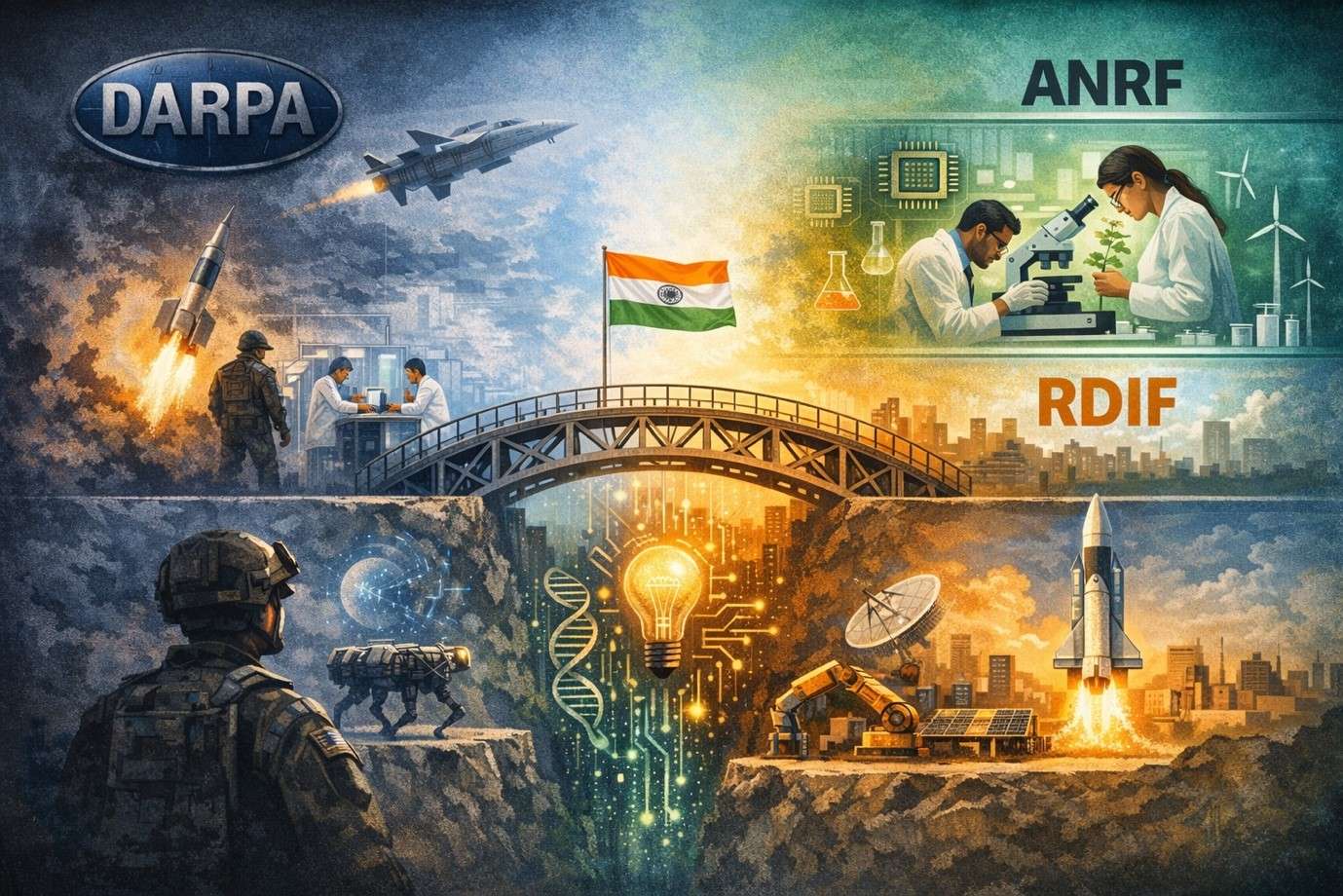
Every serious deeptech ecosystem eventually develops state backed risk capital. The question is never whether the state intervenes. The real question is where it intervenes and how effectively it does so.
From that perspective, the Anusandhan National Research Foundation (ANRF) and the Research Development and Innovation Fund (RDIF) are often misunderstood. They are not designed to replicate the Défense Advanced Research Projects Agency (DARPA).
DARPA’s model is deliberately extreme. It focuses on narrowly defined mission problems, accepts very high risk with equally high consequences, empowers autonomous program managers, and applies strict termination decisions. DARPA does not prioritize startups. Its objective is capability creation, even when most projects fail publicly.
ANRF is structured very differently. It is more academic in orientation, consensus driven, and institution focused. Its strength does not lie in speed or spectacle. Its strength lies in depth.
ANRF emphasizes sustained research funding, alignment with national priorities such as semiconductors, climate technology, artificial intelligence, advanced materials, and biotechnology, and incentives that encourage movement beyond academic publication toward real world translation.
From a deeptech perspective, this distinction matters. The quality of startups downstream is determined by the quality of problem selection and research infrastructure upstream. ANRF’s primary impact is unlikely to be headline generating unicorns. Its impact will be reflected in stronger laboratories, higher quality intellectual property, and research programs with realistic pathways out of the lab.
This is not DARPA-style breakthrough velocity. It is foundation building, an area where India has historically lacked sufficient depth.
So let’s now look at RDIF and see why its role is closer to ARPA E than many observers realize.
Why RDIF May Matter More Than It Appears
If ANRF strengthens the front end of India’s innovation pipeline, RDIF is designed to address the most fragile phase in deeptech development: translation.
This phase is characterized by high technical uncertainty, distant revenue timelines, hesitation from venture capital, and the absence of bank financing.
In the United States, this gap is partially addressed by the Advanced Research Projects Agency for Energy (ARPA E). ARPA E operates between academia and venture capital. It does not scale companies. Its role is to reduce technical uncertainty until market based capital can take over.
RDIF is conceptually similar, but broader in scope. It is not limited to energy. It focuses on the progression from prototype to pilot to early deployment. Its purpose is to absorb technical risk before venture capital enters the picture.
From a venture capital perspective, this function is critical. When venture capital is forced to price unresolved scientific risk using growth capital frameworks, outcomes deteriorate. Companies raise too early, overstate readiness, and optimize for perception rather than truth.
If RDIF is executed professionally, it reverses this pattern. It improves risk sequencing, attracts private capital rather than displacing it, and allows founders to remain honest for longer periods.
Horizon Europe offers a useful point of comparison. It demonstrates patience, scale, and collaborative strength, but struggles with commercialization. ANRF without RDIF risks a similar outcome. RDIF is intended to provide the bridge that Horizon Europe often lacks.
Taken together, ANRF and RDIF are not about copying Western models. They are about repairing India’s missing middle, the handoff between research, capital, and deployment.
They will fail if capital allocation becomes bureaucratic, success is measured by spending rather than de risking, or industry participation is absent in the early stages.
They can succeed if technical rigor is enforced, program leadership is granted autonomy, and failure is treated as learning rather than scandal.
The bottom line is simple.
ANRF builds depth.
RDIF builds bridges.
In deeptech, nations do not lose because they lack ideas. They lose because they fail to fix the middle.
So how should founders in the US, Europe looking at India, use this information. We shall do just that in the coming days!
Table of Content
- 1. ANRF and RDIF Are Not India’s DARPA and That Is the Point
- 2. Why RDIF May Matter More Than It Appears