

Quantum founders in India keep making the same mistake. They design the company like the science doesn't matter.
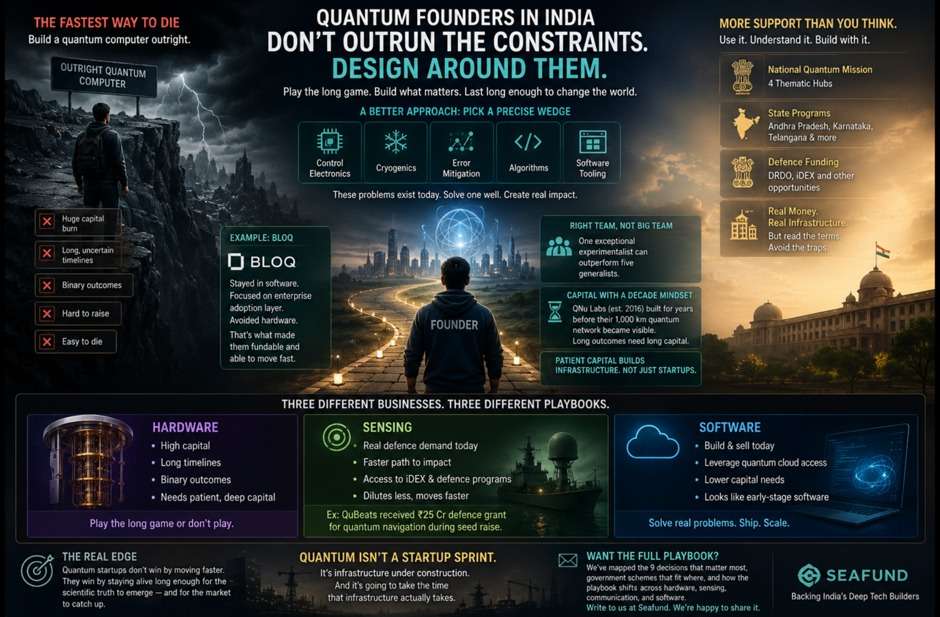
We’ve been spending time with quantum founders across the country, and one pattern keeps showing up. The founders who actually make progress aren’t trying to outrun the constraints they’re working inside. They design around them on purpose, starting from the first technical decision and carrying all the way through to how they raise money years later.
Here’s the part that caught us off guard a little. Trying to build a quantum computer outright is one of the fastest ways to die as a company. The founders who survive tend to pick a precise wedge instead, something like control electronics, cryogenics, error mitigation, algorithms, or software tooling. These problems all exist well before fault tolerant quantum computing actually arrives, and solving even one of them properly can matter enormously on its own. Bloq is a good example of this working in practice. They stuck to software, focused entirely on the enterprise adoption layer, and stayed away from hardware altogether. That narrower bet is what made the company fundable and able to move quickly at a time when most hardware approaches in the country were still years away from a working device.
The same thinking applies to how these companies build their teams. Quantum doesn’t need a big team. It needs the right five people instead of the wrong fifteen. We keep seeing one exceptional experimentalist outperform five generalists, almost every time.
Capital has to be built with a decade in mind, not a demo. QNu Labs has been working on quantum key distribution since 2016, and it took years of patient building before their 1,000 kilometre quantum network, among the longest in the world outside China, became something visible enough for people to point to. That kind of outcome simply isn’t available to a company that’s been funded on eighteen month return expectations. One investor with the wrong expectations baked in from the start can end up forcing shortcuts that quietly destroy years of careful work.
Something else we think founders underweight is just how different quantum hardware, quantum sensing, and quantum software actually are from each other as businesses, even though they all get lumped under the same word. Hardware needs capital that can sit with genuinely binary outcomes for long stretches of time. Sensing already has real defence demand today, not a decade from now, and a funding path through programs like iDEX that moves faster and dilutes less. QuBeats picked up a Rs 25 crore defence grant for quantum navigation while they were still raising their seed round. Software can build and sell right now against existing quantum cloud access, with capital needs that look a lot closer to an early stage software company than a hardware deep tech one. Three genuinely different playbooks hiding under one word.
There’s also more government support out there than most founders seem to realise. The National Quantum Mission’s four hubs, state level programs in Andhra Pradesh, Karnataka, and Telangana, and defence funding through DRDO and iDEX all add up to real money and real infrastructure. There are also a few real traps in there for founders who don’t read the terms closely before signing anything.
Quantum startups don’t win by moving faster than everyone else. They win by staying alive long enough for the underlying scientific truth to actually emerge, and for the market to catch up to it once it does.
Quantum isn’t a startup sprint. It’s infrastructure under construction, and it’s going to take the time that infrastructure actually takes. We put together a fuller breakdown of this, covering the nine decisions that matter most, where the government schemes actually fit into each one, and how the playbook shifts across hardware, sensing, communication, and software. If you’re building in this space and want the longer version, write to us at Seafund. We’re happy to share it.
FAQs
1. How can quantum computing startups in India raise funding?
Quantum startups can raise funding through deeptech venture capital, government grants, strategic partnerships, and initiatives like the National Quantum Mission, iDEX, and DRDO. A combination of patient capital and non-dilutive funding often works best.
2. What are the biggest challenges for quantum startups in India?
Long R&D cycles, access to specialized talent, infrastructure, and patient investors are among the biggest challenges. Focusing on a clear market application can help startups scale more effectively.
3. Which sectors offer the biggest opportunities for quantum technology startups?
Key opportunities include quantum computing, quantum communication, quantum sensing, cybersecurity, healthcare, defence, and financial services, each with different commercialization timelines.
4. What is the National Quantum Mission and how does it support startups?
The National Quantum Mission (NQM) supports startups through funding, research infrastructure, technology hubs, and collaborations with academia and industry to accelerate quantum innovation in India.
5. Why do many quantum startups struggle to scale?Many startups try to build complete quantum systems too early. Successful companies usually focus on solving a specific challenge, such as software, sensing, cybersecurity, or enabling technologies.
6. What do venture capital firms look for in quantum startups?
Investors evaluate strong IP, technical expertise, market potential, commercialization strategy, and a realistic roadmap. Deeptech VCs also look for founders who can execute over long development cycles.
7. Why is India becoming a hub for quantum technology startups?
Government initiatives like the National Quantum Mission, growing research capabilities, defence demand, and an expanding deeptech ecosystem are making India an attractive destination for quantum innovation and investment.
Table of Content
- 1. What Founder-Market Fit Really Means
- 2. Why Founder-Market Fit Matters More in Deeptech Than SaaS
- 3. Examples of Strong vs. Weak Founder-Market Fit
- 4. How VCs Evaluate Founders for Market Fit
- 5. How Founders Can Signal Fit During Fundraising
- 6. The Seafund Lens: FMF in Practice
- 7. FAQs